
Bone Grafts in Johns Creek
When tooth loss causes jawbone atrophy and resorption, bone grafting restores solid foundations to place implants of proper length and width and restore facial aesthetics.
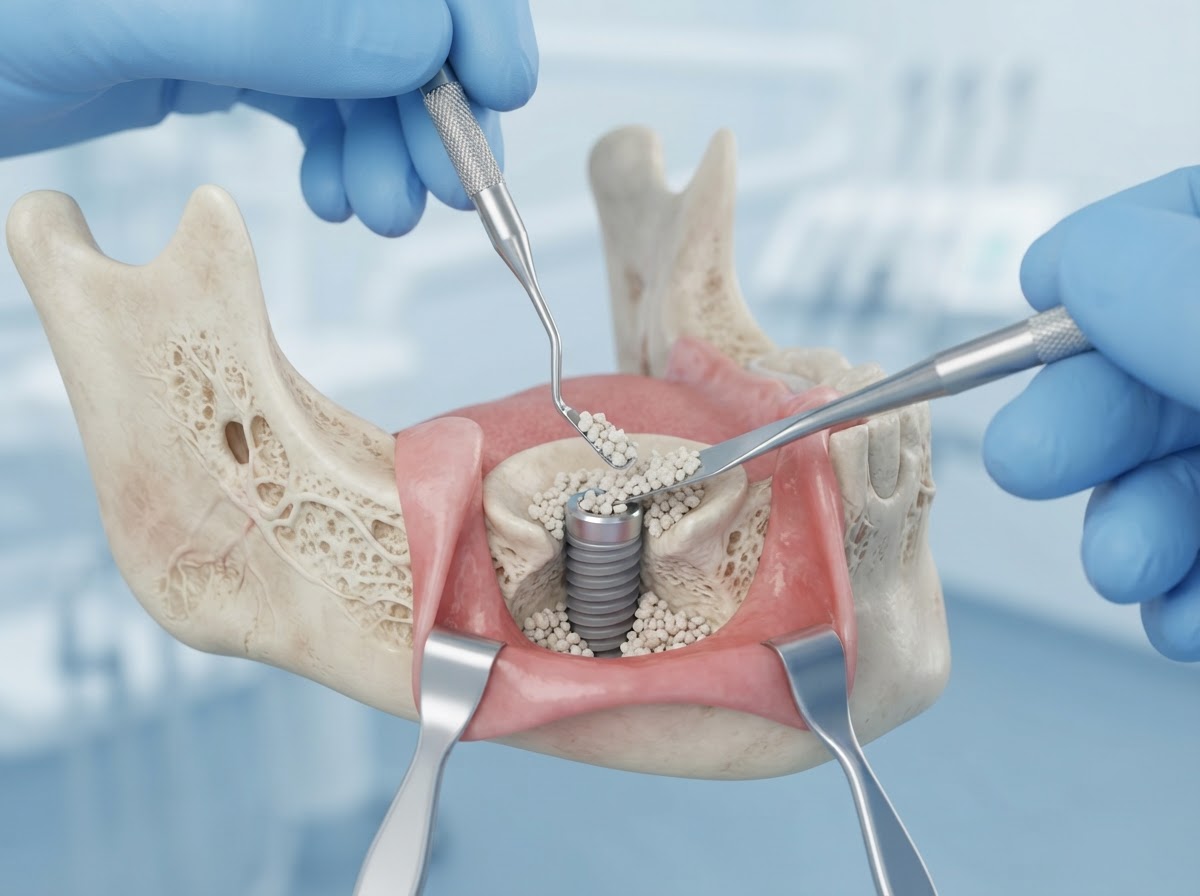
WHAT IS BONE GRAFTING?
Over a period of time, the jawbone associated with missing teeth atrophies and is reabsorbed. This often leaves a condition in which there is poor quality and quantity of bone suitable for placement of dental implants. In these situations, most patients are not candidates for placement of dental implants.
With bone grafting, we now have the opportunity to not only replace bone where it is missing, but also the ability to promote new bone growth in that location! This not only gives us the opportunity to place implants of proper length and width, it also gives us a chance to restore functionality and esthetic appearance.
TYPES OF BONE GRAFTS
Autogenous Bone
Autogenous bone grafts, also known as autografts, are made from your own bone, taken from somewhere else in the body. The bone is typically harvested from the chin, jaw, lower leg bone, hip, or the skull. Autogenous bone grafts are advantageous in that the graft material is live bone, meaning it contains living cellular elements that enhance bone growth.
However, one downside is that it requires a second procedure to harvest bone.
Allogenic Bone
Allogenic bone, or allograft, is dead bone harvested from a cadaver, then processed using a freeze-dry method to extract the water via a vacuum. Unlike autogenous bone, allogenic bone cannot produce new bone on it’s own. Rather, it serves as a framework or scaffold over which bone from the surrounding bony walls can grow to fill the defect or void.
Xenogenic Bone
Xenogenic bone is derived from non-living bone of another species, usually a cow. The bone is processed at very high temperatures to avoid the potential for immune rejection and contamination. Like allogenic grafts, xenogenic grafts serve as a framework for bone from the surrounding area to grow and fill the void.
BONE GRAFT SUBSTITUTES
As a substitute to using real bone, many synthetic materials are available as a safe and proven alternative, including:
Demineralized Bone Matrix (DBM) / Demineralized Freeze-Dried Bone Allograft (DFDBA):
This product is processed allograft bone, containing collagen, proteins, and growth factors extracted from allograft bone. It is available in powder, putty, chips, or injectable gel.
Graft Composites:
Consist of other bone graft materials and growth factors, including collagen/ceramic composites closely resembling natural bone structure.
Bone Morphogenetic Proteins (BMP):
Proteins naturally produced in the body that promote and regulate new bone formation and healing without a secondary donor site.
Each bone grafting option has its own risks and benefits. Dr. Egolum will determine which type of bone graft material is right for you.
Bone Grafting Topics & Procedures
Jaw Bone Health →
How teeth maintain bone and consequences of tooth loss.
Jaw Bone Loss & Deterioration →
Extractions, periodontitis, dentures, trauma, and osteomyelitis.
About Bone Grafting →
Autografts, allografts, xenografts, and substitute materials.
Ridge Augmentation →
Recreating natural contour and height of the alveolar ridge.
Sinus Lift Procedure →
Raising the sinus floor to anchor upper jaw dental implants.
Socket Preservation →
Minimizing bone loss and gum collapse right after extraction.
Rebuild Your Bone Foundation Today
Schedule a bone grafting consultation with Dr. Egolum in Johns Creek, GA.
Request Appointment Online →